Vision-Based Automation in Practice: Where It Fits, What It Delivers, and How It Pays Back

Vision-based automation is no longer an experimental upgrade reserved for advanced factories. Across global manufacturing, it has become a core production tool – used to stabilize quality, reduce scrap, and protect throughput at scale.
Yet many manufacturers still struggle with the same questions:
- Is AI vision really better than manual inspection?
- Where exactly should vision systems sit in the production line?
- Will inspection slow down throughput?
- How fast does vision-based automation actually pay back?
This article answers those questions from a practical, factory-floor perspective – connecting comparison, integration, and ROI into one clear decision framework.
AI Vision vs Manual Inspection: The Real Comparison That Matters
Manual inspection has long been the default in quality control. It is flexible, low upfront cost, and easy to deploy. But as production volumes increase and tolerance windows tighten, its limitations become unavoidable.
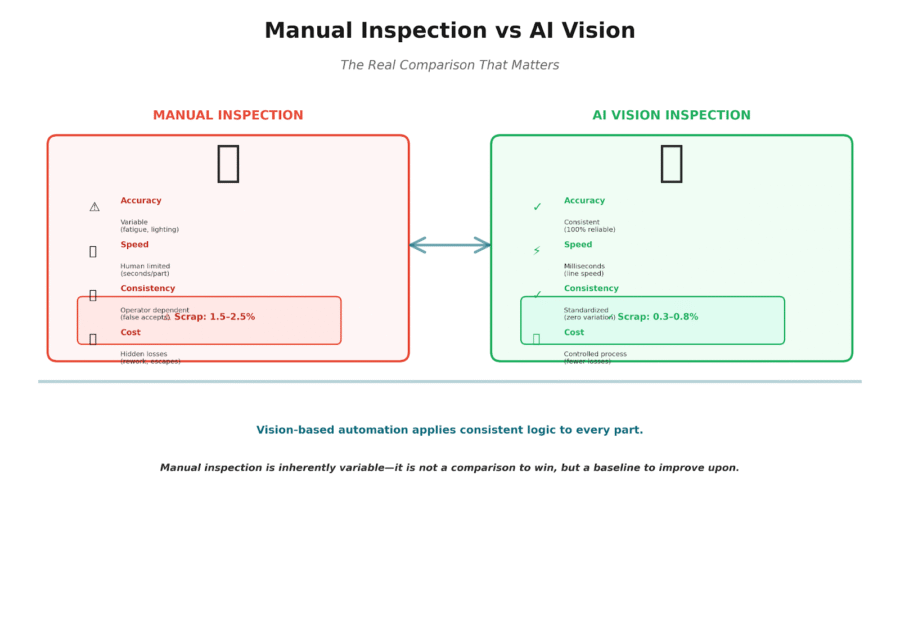
Accuracy
Manual inspection is inherently variable. Fatigue, shift changes, lighting conditions, and subjective judgment all impact results.
Vision-based automation applies consistent inspection logic to every single part. AI vision systems do not “get better or worse” over a shift – they apply the same criteria every time.
Speed
Manual inspection speed is capped by human reaction time. As line speed increases, inspection accuracy usually drops.
Vision systems inspect in milliseconds. They operate at line speed without compromise, making them suitable for high-throughput and short cycle-time applications.
Consistency
Two operators inspecting the same part may not reach the same conclusion. This inconsistency leads to false accepts, false rejects, and internal quality disputes.
Vision-based inspection eliminates this variation by standardizing acceptance criteria across all shifts and operators.
Cost (Beyond Headcount)
While manual inspection appears cheaper initially, hidden costs add up:
- Rework and scrap from missed defects
- Over-inspection and unnecessary rejects
- Quality escapes reaching customers
Vision-based automation shifts inspection from a reactive cost to a controlled process – reducing downstream losses rather than just labor.
Where Vision Systems Fit in a Modern Automation Line
One of the most common mistakes manufacturers make is treating vision systems as standalone tools. In reality, vision delivers maximum value when designed as part of the automation flow.
Typical Vision Integration Points
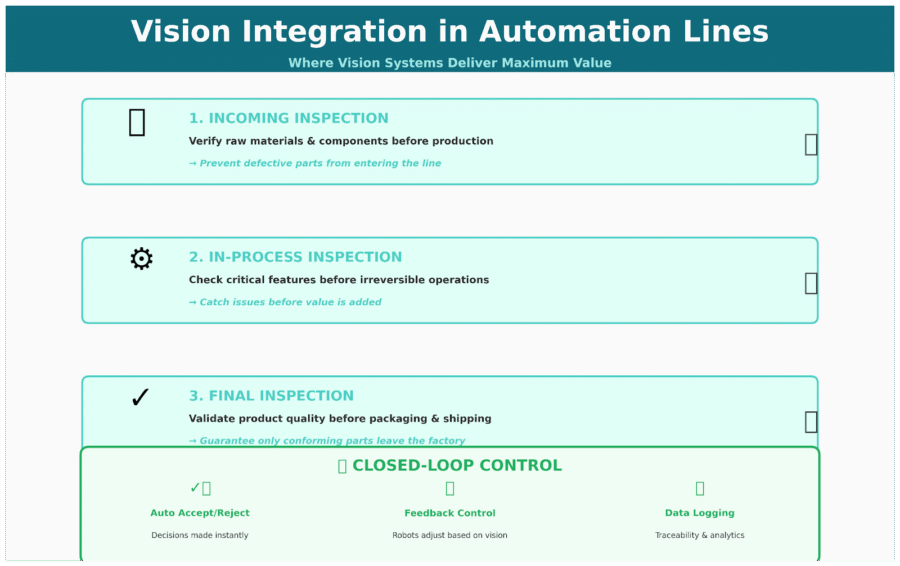
In a modern automation line, vision systems are commonly placed at:
- Incoming inspection – verifying raw parts or components
- In-process inspection – checking features before irreversible operations
- Post-process inspection – validating final quality before packing
- Robotic guidance – enabling accurate pick, place, and orientation
Vision acts as both eyes and decision-maker, feeding data back into machines, robots, and control systems.
Vision + Automation = Closed-Loop Control
When integrated correctly:
- Vision systems trigger accept/reject decisions automatically
- Robots adjust actions based on visual feedback
- Data is logged for traceability and analysis
This transforms inspection from a checkpoint into a control mechanism.
Does Vision-Based Inspection Slow Down Production?
This is a common concern – and a valid one.
The short answer: well-designed vision systems do not slow production. Poorly designed ones do.
Why Vision Often Improves Throughput
Vision-based automation actually reduces slowdowns by:
- Eliminating manual handling for inspection
- Preventing defective parts from moving downstream
- Reducing line stops caused by late defect detection
In many cases, manufacturers see smoother flow because issues are caught earlier and automatically, not after value has already been added.
The Engineering Difference
Vision systems must be:
- Matched to cycle time requirements
- Properly synchronized with machines and robots
- Designed with stable lighting and fixturing
When these factors are addressed upfront, inspection runs in parallel—not as a bottleneck.
How Vision-Based Automation Reduces Scrap Without Slowing Production
Scrap reduction is one of the strongest ROI drivers for vision-based automation.
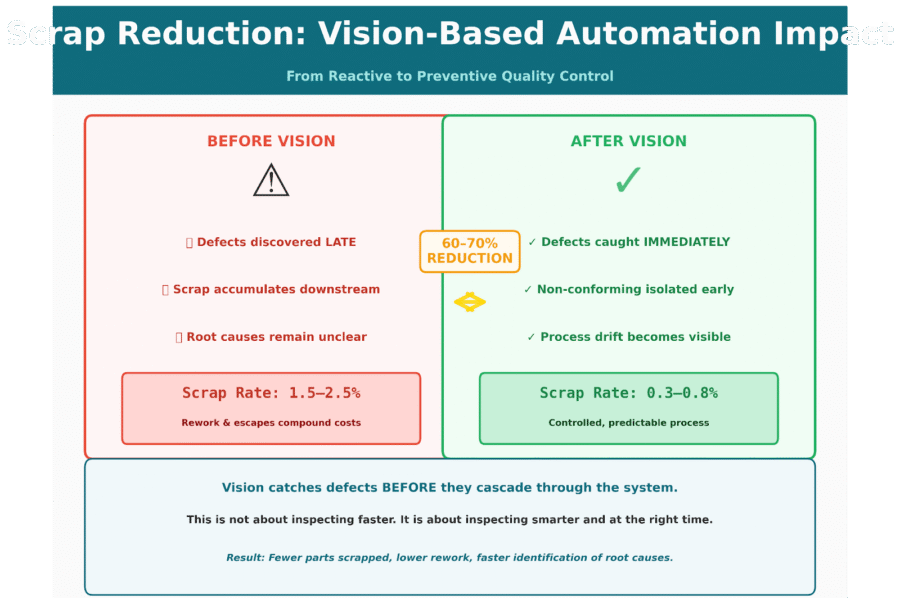
Before Vision Automation
- Defects detected late or inconsistently
- Scrap accumulates downstream
- Root causes remain unclear
After Vision Automation
- Defects detected immediately
- Non-conforming parts are isolated early
- Process drift becomes visible
This shift from reactive quality to preventive quality significantly reduces material loss and rework – without impacting cycle time.
Vision systems also generate data that helps engineering teams:
- Identify recurring defect patterns
- Improve upstream processes
- Reduce long-term quality variability
ROI: How Vision-Based Automation Pays Back
For manufacturers evaluating upgrades or replacements, ROI is the final decision factor.
Vision-based automation typically delivers value through multiple channels:
Primary ROI Drivers
- Reduced scrap and rework
- Lower quality-related downtime
- Fewer customer complaints and returns
- Stable inspection at higher volumes
Secondary ROI Drivers
- Reduced operator dependency
- Better traceability and audit readiness
- Data for continuous improvement
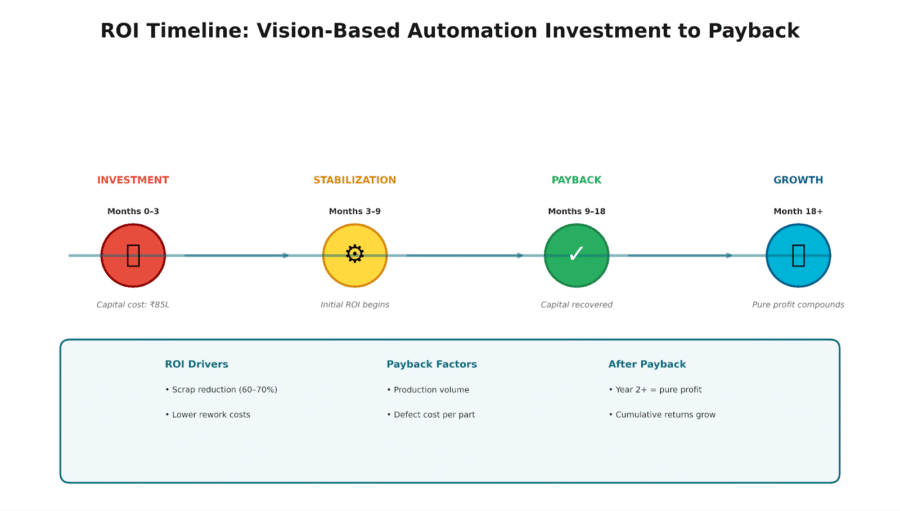
In most production environments, vision systems pay back within 9-18 months, depending on volume, defect cost, and inspection criticality.
The key is not over-automating – but targeting the right inspection points.
What Buyers Should Evaluate Before Investing
To ensure vision-based automation delivers results, manufacturers should assess:
- Lighting stability – the foundation of reliable vision
- Fixturing repeatability – part position must be controlled
- False reject tolerance – inspection logic must be realistic
- Data handling – inspection results should be logged and usable
- Scalability – systems should adapt to future products
Vision systems fail not because the technology is weak – but because integration is underestimated.
Why Vision-Based Automation Is a Strategic Upgrade
Vision is no longer just about defect detection. It is about:
- Protecting throughput
- Stabilizing quality
- Enabling smarter automation
When designed as part of the production system – not bolted on later – vision-based automation becomes a competitive advantage, not a cost center.
How CNN Robotics Approaches Vision-Based Automation
At CNN Robotics, vision systems are engineered as part of the automation architecture—not as add-ons.
We focus on:
- Matching vision performance to takt time
- Integrating inspection with robotics and SPMs
- Designing for low false rejects and high reliability
- Ensuring inspection data supports ROI, traceability, and scale
If you are evaluating whether to replace manual inspection or upgrade an existing line, the right question is not “Can vision work?”
It is “Will it deliver measurable value in our production reality?”
📞 +45 42 31 52 36
📧 sales@cnn-robotics.com
Let’s design vision-based automation that improves quality, protects throughput, and pays back – without slowing your line.
Frequently Asked Questions (FAQs)
1. What is vision-based automation in manufacturing?
Vision-based automation uses industrial cameras and software to inspect, guide, and verify parts during production. It replaces or supports manual inspection by delivering faster, more consistent, and data-driven quality control.
2. How does AI vision compare to manual inspection?
AI vision systems outperform manual inspection in consistency, speed, and repeatability. While manual inspection depends on operator judgment and fatigue, vision-based systems apply the same inspection logic to every part, every time.
3. Can vision-based inspection keep up with high-speed production lines?
Yes. When properly designed, vision systems inspect parts in milliseconds and run in parallel with production. They do not slow down the line and often improve flow by detecting defects earlier.
4. Where should vision systems be placed in an automation line?
Vision systems can be integrated at multiple points, including incoming inspection, in-process checks, post-process validation, and robotic guidance. The optimal placement depends on defect criticality and process flow.
5. Does vision-based automation reduce scrap?
Yes. Vision systems detect defects early and consistently, preventing defective parts from moving downstream. This significantly reduces scrap, rework, and quality-related downtime.
6. How long does it take for vision-based automation to pay back?
In most manufacturing environments, vision-based automation pays back within 9–18 months. Payback depends on production volume, defect cost, inspection frequency, and integration quality.
7. What are the most common causes of vision system failure?
Most failures are due to poor lighting design, unstable part positioning, unrealistic inspection criteria, or inadequate integration – not the vision technology itself.
8. Can vision systems be integrated into existing production lines?
Yes. Vision-based automation can be added to both new and existing lines, provided the system is engineered around cycle time, fixturing, and data flow requirements.
9. Does vision-based automation increase false rejects?
Poorly designed systems can. Well-engineered vision systems are tuned to balance detection accuracy with realistic tolerances, minimizing false rejects while protecting quality.
10. What data does a vision system typically generate?
Vision systems generate inspection results, defect images, pass/fail data, and timestamps. This data can support traceability, quality audits, and continuous process improvement.
11. Is vision-based automation suitable for high-mix or variable products?
Yes. With proper configuration and scalable design, vision systems can handle product variation while maintaining inspection reliability.
12. How does CNN Robotics approach vision-based automation differently?
CNN Robotics designs vision systems as part of the overall automation architecture – aligned with takt time, throughput, and ROI – ensuring inspection improves production performance rather than becoming a bottleneck.