Before You Invest in Vision-Based Automation: A Practical Checklist for Reliable Results and Scalable ROI


Vision-based automation has become a key enabler for quality control, traceability, and throughput stability in modern manufacturing. Yet despite proven technology, many vision projects fail to deliver expected ROI.
The reason is rarely the camera or software.
Most failures stem from engineering oversights during evaluation and integration – issues that surface only after commissioning, when correction is costly.
This checklist is designed for manufacturers who are close to finalizing a vision-based automation investment and want confidence that it will perform reliably, scale with production, and pay back as expected.
1. Lighting: The Foundation of Every Vision System
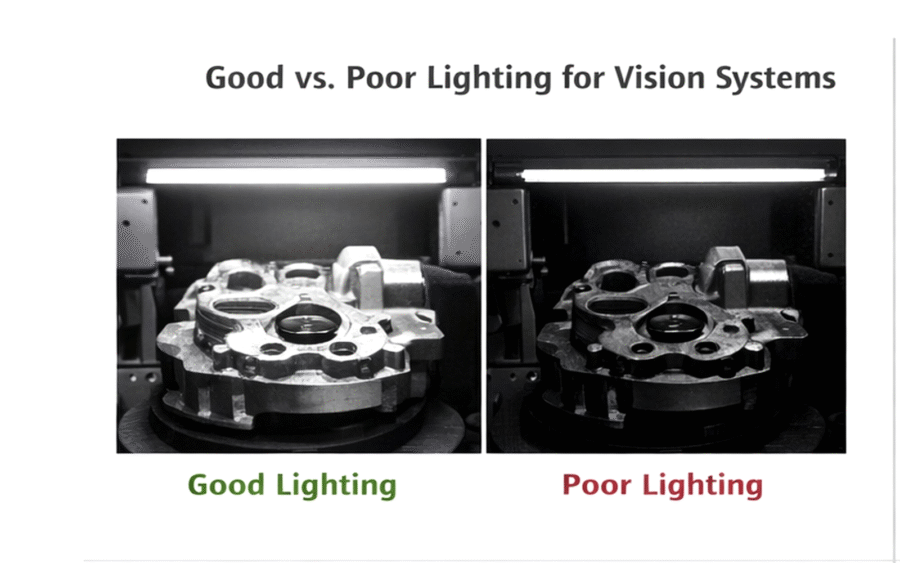
Lighting is the single most critical factor in vision performance – and the most underestimated.
No vision algorithm can compensate for unstable or poorly designed lighting.
What to Check
- Is lighting controlled and isolated from ambient variations?
- Is the lighting type matched to surface finish, color, and geometry?
- Is the lighting solution robust for dust, vibration, and temperature changes?
Inconsistent lighting leads directly to false rejects and missed defects, eroding trust in the system.
Lighting should be treated as a process component, not an accessory.
2. Fixturing and Part Presentation: Consistency Before Intelligence
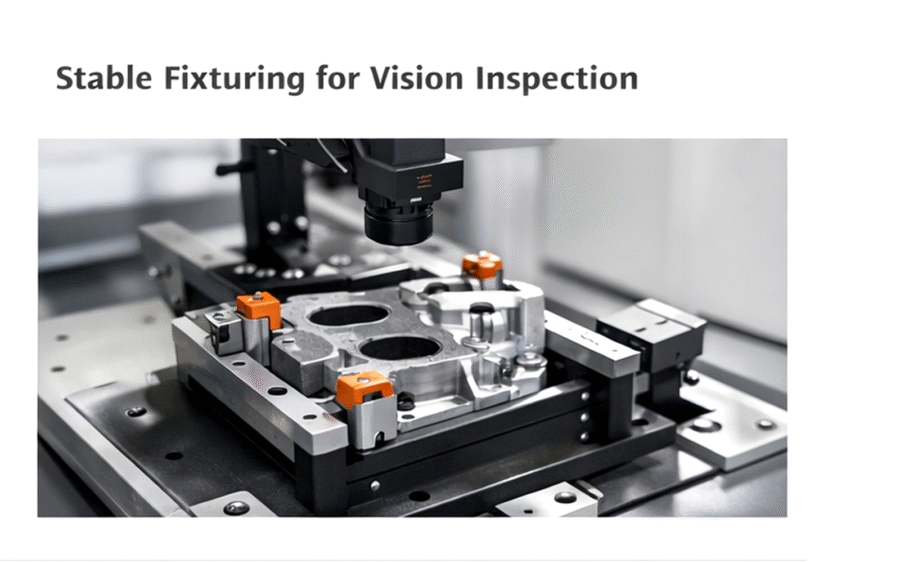
Vision systems assume repeatability. If parts arrive differently every cycle, inspection results will vary – no matter how advanced the software is.
What to Check
- Is part position repeatable within defined tolerances?
- Is the fixture designed for vision access, not just holding the part?
- Is there protection against vibration or movement during inspection?
Stable fixturing reduces inspection complexity and improves long-term reliability.
In many cases, better fixturing delivers more value than more complex vision algorithms.
3. False Rejects: The Fastest Way to Lose Operator Trust
False rejects are one of the most common reasons vision systems get bypassed on the shop floor.
If operators do not trust inspection results, the system stops adding value.
What to Check
- Are inspection tolerances realistic and process-capable?
- Is there a clear method to review and classify rejects?
- Can inspection parameters be tuned without breaking validation?
The goal is not zero false rejects – it is predictable, explainable inspection behavior.
Vision systems must support production, not create friction.
4. Cycle Time and Throughput Compatibility
Vision-based automation should run with the line, not against it.
Inspection that disrupts takt time quickly becomes a bottleneck.
What to Check
- Can inspection complete within available cycle time?
- Is image processing running in parallel with production?
- Are reject handling and part flow fully automated?
Well-integrated vision systems inspect in milliseconds and remain invisible to throughput.
Poorly integrated systems introduce micro-stoppages that compound over time.
5. Data Handling: Inspection Is Only Half the Value
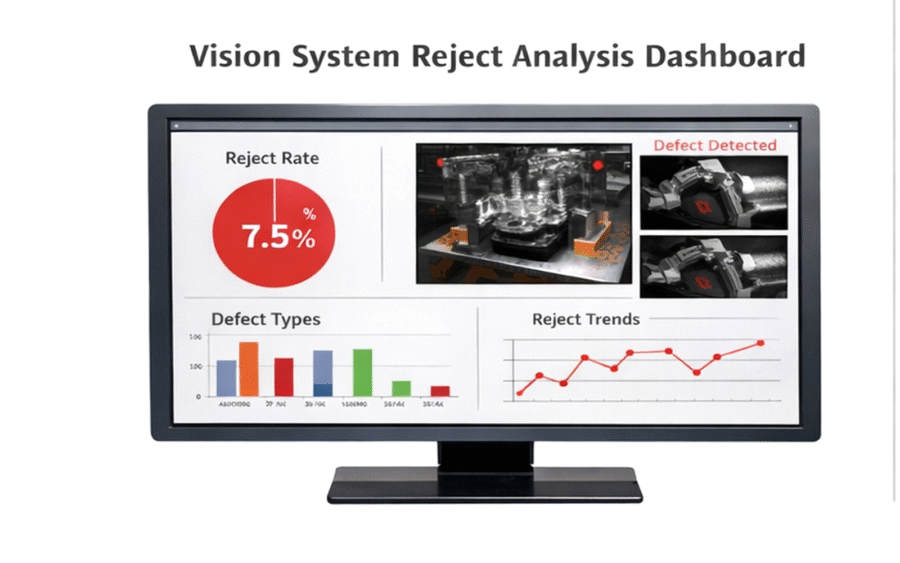
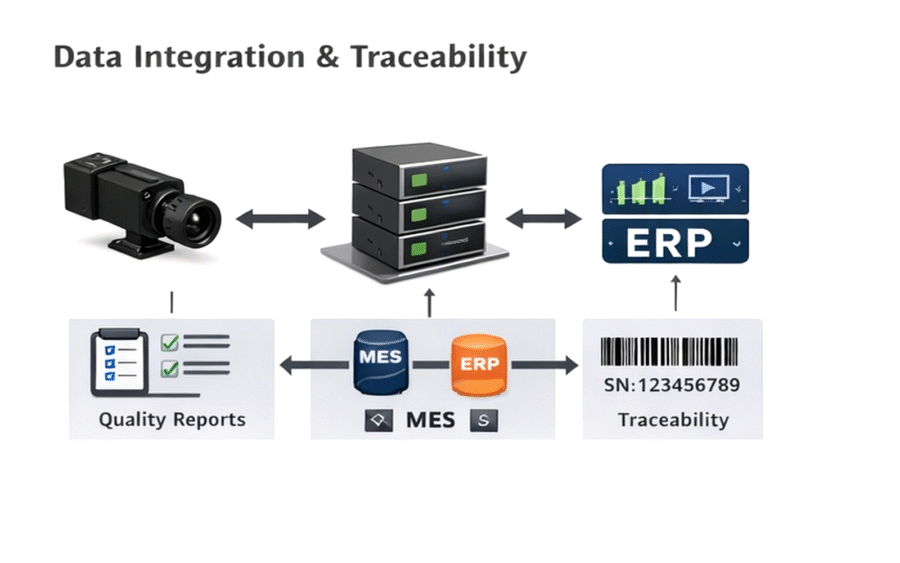
Modern vision systems generate valuable production data – but only if it is captured and used.
What to Check
- Is inspection data logged automatically?
- Can data support traceability and audits?
- Is data structured for analysis, not just storage?
Without proper data handling, vision becomes a pass/fail tool instead of a continuous improvement asset.
6. Scalability and Future Proofing
Vision systems should not be designed only for today’s product.
Production volumes, variants, and quality requirements evolve.
What to Check
- Can the system adapt to new variants without redesign?
- Is the hardware platform expandable?
- Can inspection logic scale without revalidation complexity?
Scalable systems protect ROI over the full lifecycle – not just initial deployment.
7. Validation and Change Management
Vision-based inspection often supports quality-critical decisions. That makes validation essential.
What to Check
- Is there a documented validation strategy?
- Are changes controlled and traceable?
- Can updates be implemented without prolonged downtime?
A clear validation framework reduces risk and simplifies future upgrades.
Why This Checklist Matters for ROI
Most vision projects that underperform do not fail technically – they fail operationally.
By addressing these factors early, manufacturers:
- Reduce commissioning delays
- Minimize post-install tuning
- Avoid production disruptions
- Achieve predictable ROI timelines
Risk-aware evaluation leads to faster stabilization and quicker payback.
How CNN Robotics Approaches Vision-Based Automation
At CNN Robotics, vision systems are engineered as part of the automation solution – not treated as standalone components.
Our approach focuses on:
- Production-ready lighting and fixturing design
- Realistic inspection logic that supports throughput
- Data handling aligned with traceability and ROI
- Scalable architectures that grow with your factory
By addressing risk upfront, we help manufacturers invest with confidence.
If you are evaluating vision-based automation and want to avoid common pitfalls before committing, this conversation should happen early – not after installation.
📞 +45 42 31 52 36
📧 sales@cnn-robotics.com
Invest once. Inspect reliably. Scale without surprises.
Frequently Asked Questions (FAQs)
1. Why do many vision-based automation projects fail to deliver ROI?
Most failures are not due to camera or software limitations. They result from poor lighting design, unstable fixturing, unrealistic inspection criteria, or weak system integration.
2. Is lighting really that important for vision systems?
Yes. Lighting is the foundation of reliable vision inspection. Inconsistent or poorly designed lighting directly causes false rejects and missed defects, regardless of software capability.
3. Can AI vision compensate for inconsistent part positioning?
Only to a limited extent. Vision systems still require stable and repeatable part presentation. Good fixturing simplifies inspection and improves long-term reliability.
4. What causes false rejects in vision-based inspection?
False rejects are typically caused by lighting variation, overly tight tolerances, surface inconsistencies, or process instability rather than vision technology limitations.
5. How can false rejects be reduced without compromising quality?
By aligning inspection tolerances with real process capability, stabilizing lighting and fixturing, and tuning inspection logic using real production data.
6. Will vision-based inspection slow down our production line?
No- if designed correctly. Vision systems inspect in milliseconds and run in parallel with production. Throughput issues arise only when integration is poorly planned.
7. How does vision-based automation support traceability?
Vision systems can automatically log inspection results, images, timestamps, and part IDs, supporting audits, quality investigations, and compliance requirements.
8. Can vision systems be scaled for future product variants?
Yes. When designed on scalable hardware and software platforms, vision systems can adapt to new variants without full redesign or excessive revalidation.
9. What should we validate before going live with a vision system?
Inspection accuracy, false reject rate, cycle time impact, data integrity, and change management processes should all be validated before full production release.
10. Is vision-based automation suitable for regulated industries?
Yes. Vision systems are widely used in regulated industries when proper validation, documentation, and data traceability are in place.
11. Can vision systems be integrated into existing production lines?
Yes. Vision-based automation can be retrofitted into existing lines, provided lighting, fixturing, and cycle time constraints are properly addressed.
12. How does CNN Robotics reduce risk in vision-based automation projects?
CNN Robotics addresses risk upfront by engineering lighting, fixturing, inspection logic, data handling, and scalability together- ensuring reliable performance and predictable ROI.