Blog Post
Why Food & Beverage Plants Automate Palletizing in 2026
Manual palletizing is becoming a labour, safety and throughput bottleneck. Learn when food and beverage manufacturers should evaluate robotic palletizing.
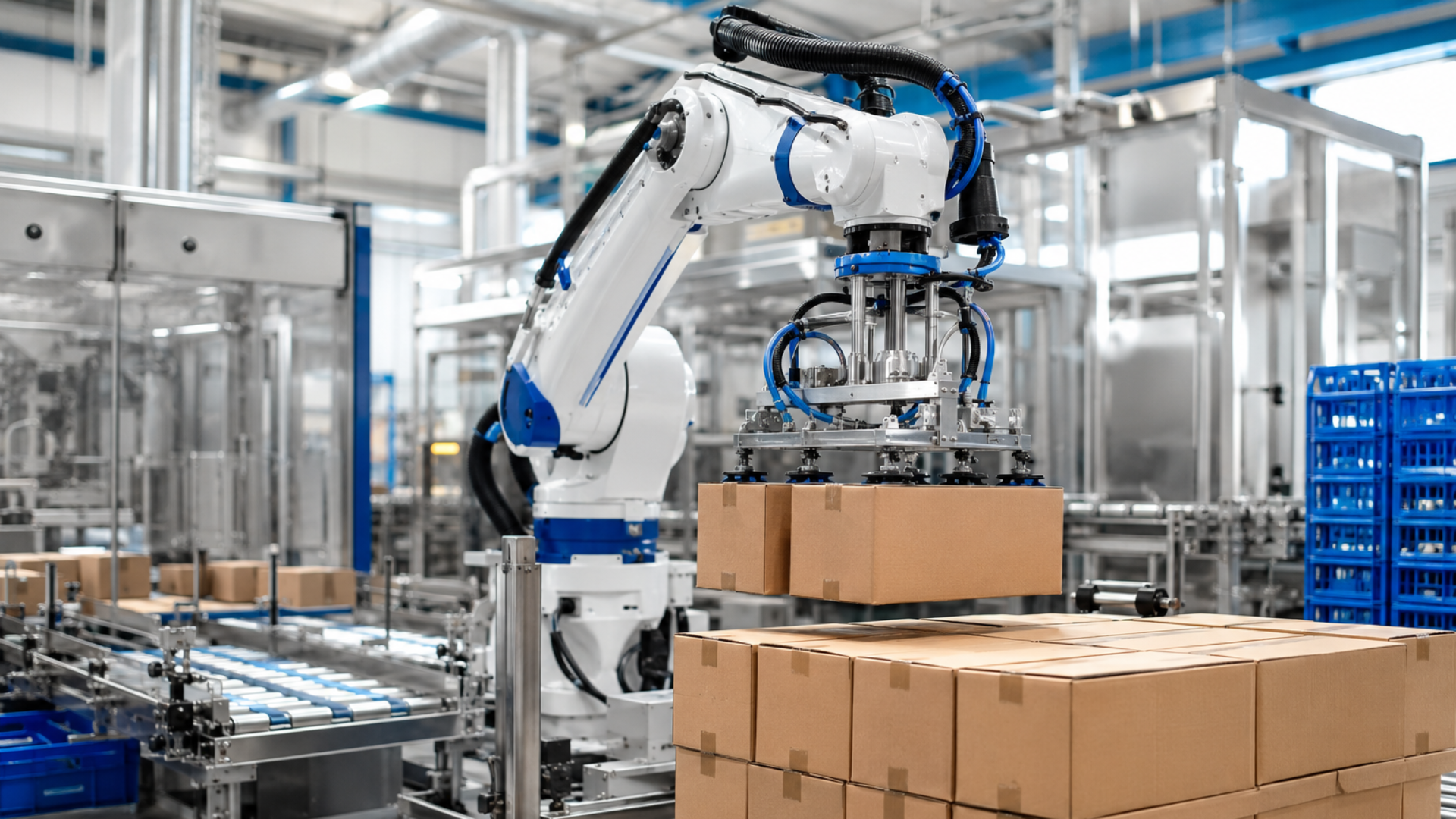
Why Food & Beverage Manufacturers Are Automating Palletizing in 2026
Every Delay Has a Cost
Walk into almost any food manufacturing facility today and you'll notice the same challenge.
Production lines are becoming faster. Customer demand continues to increase. Product variety is expanding.
But one area often remains surprisingly manual — the end of the production line.
Operators continue lifting heavy cartons. Products wait on conveyors. Finished goods accumulate while workers manually stack pallets.
It may seem like a small operational issue. In reality, it affects almost every key performance indicator inside a manufacturing business.
Every minute spent waiting for manual palletizing slows production. Every incorrectly stacked pallet increases the risk of product damage. Every unavailable operator creates another production bottleneck. And every hour of overtime increases operating costs.
For years, manufacturers accepted these inefficiencies as "part of the business." That mindset is rapidly changing.
Across Europe, North America, and Asia, food manufacturers are investing heavily in robotic palletizing — not because robots are becoming more affordable, but because business expectations are changing.
Factory owners no longer measure success by the number of robots installed. They measure success through measurable business outcomes:
Higher production throughput
Lower labor dependency
Better product quality
Reduced operating costs
Improved workplace safety
Faster return on investment
The discussion has shifted from automation technology to business performance. That is exactly why palletizing has become one of the fastest-growing automation investments in food manufacturing.
Why Manual Palletizing Is Becoming a Competitive Disadvantage
Manual palletizing was once considered a simple task. Today, it has become one of the biggest operational bottlenecks inside food manufacturing.
The challenge isn't just labor. It's consistency.
Most factories now operate multiple shifts while producing dozens — or even hundreds — of product variations every day. Each production run may require a different pallet pattern, carton size, stacking height, or packaging configuration. Manual operators must constantly adapt.
As production speed increases, fatigue also increases. Fatigue leads to:
Incorrect pallet patterns
Damaged packaging
Worker injuries
Production delays
Inconsistent quality
These problems don't only affect operations. They directly affect profitability.
Many manufacturers initially focus on reducing labor costs. However, labor represents only one part of the overall business impact. Manual palletizing also creates hidden costs that are rarely measured accurately.
Hidden Business Costs of Manual Palletizing
These costs accumulate every single day. Many manufacturers don't notice the financial impact until production demand exceeds manual capacity. By then, expansion becomes difficult without hiring additional operators — a challenge that has become increasingly difficult across the manufacturing sector.
The Skilled Labor Challenge Isn't Going Away
One of the biggest reasons manufacturers are automating palletizing in 2026 isn't technology. It's people.
Across many countries, manufacturers continue facing shortages of skilled production workers. Recruitment takes longer. Training requires additional investment. Employee turnover increases operational uncertainty.
At the same time, customer expectations continue to rise. Manufacturers are expected to deliver:
Shorter lead times
Higher quality
Greater production flexibility
Lower costs
Meeting these expectations with entirely manual palletizing processes is becoming increasingly difficult.
This is why automation is no longer viewed as a replacement for people. Instead, it is viewed as a strategic investment that allows existing teams to focus on higher-value activities while repetitive, physically demanding tasks are handled consistently and safely by automated systems.
Why Robotic Palletizing Is Accelerating Across Food Manufacturing in 2026
The food and beverage industry has always operated under pressure. Manufacturers are expected to deliver higher production volumes, maintain strict quality standards, comply with food safety regulations, and respond quickly to changing customer demand — all while controlling operational costs.
In 2026, these challenges have intensified. Rather than expanding their workforce indefinitely, manufacturers are increasingly investing in intelligent automation that improves both operational performance and financial outcomes.
Robotic palletizing has emerged as one of the highest-impact automation investments because it addresses several production challenges simultaneously. Unlike manual palletizing, robotic systems can operate continuously with consistent performance, helping manufacturers achieve higher throughput, predictable quality, and greater production flexibility.
The question is no longer: "Can we automate palletizing?"
The question has become: "How much production capacity are we losing by keeping it manual?"
What Manufacturing Leaders Actually Measure
One of the biggest misconceptions about automation is that companies invest because they want robots. They don't.
Manufacturing leaders evaluate automation using business metrics — not technology specifications. Before approving any automation investment, they typically ask questions like:
How much can production increase?
How quickly can the investment pay for itself?
Will product quality become more consistent?
Can we reduce labour dependency?
Can existing production lines scale without hiring additional operators?
What operational risks will automation eliminate?
Technology is only one part of the equation. Business performance is what ultimately drives investment decisions.
Manufacturing KPI Dashboard
These KPIs are often more valuable than discussions about robot brands, payload capacity, or programming languages. Automation succeeds when business performance improves.
How CNN Robotics Approaches Every Automation Project
Every manufacturing facility is different. Different products. Different production rates. Different layouts. Different operational challenges.
Because of this, there is no universal automation solution.
At CNN Robotics, every project begins long before selecting a robot. It begins with understanding the production process. Our engineering team works closely with manufacturers to identify where automation can create measurable improvements rather than simply replacing manual work.
Our Automation Methodology
Step 1 — Production Assessment
We evaluate: current production flow, product mix, cycle times, changeover frequency, existing equipment, available floor space.
Step 2 — Process Analysis
Our engineers identify: production bottlenecks, manual handling points, quality risks, ergonomic concerns, opportunities for automation.
Step 3 — Simulation & Layout Design
Before installation begins, different production scenarios are simulated to validate: robot reach, pallet patterns, conveyor flow, safety zones, future expansion possibilities.
Step 4 — Engineering & Integration
The automation system is designed to integrate seamlessly with existing production equipment while minimizing disruption to ongoing operations.
Step 5 — Commissioning & Training
Operators receive practical training to ensure smooth adoption and long-term system reliability.
Step 6 — Ongoing Support
Automation is not a one-time installation. Continuous optimization ensures the system continues delivering measurable business value.
The Business Outcomes That Matter
Automation should never be evaluated by the number of robots installed. Its success should be measured by improvements across the manufacturing operation.
Manufacturers typically focus on outcomes such as:
✓ Higher production throughput
✓ Reduced labour dependency
✓ Improved Overall Equipment Effectiveness (OEE)
✓ Lower product damage
✓ Better pallet consistency
✓ Improved workplace safety
✓ Reduced operating costs
✓ Greater production flexibility
These improvements help manufacturers remain competitive while creating a stronger foundation for future growth.
Business Outcome Comparison
*Actual results vary depending on production volume, product type, line design, and operational requirements. Every project should be evaluated individually through a detailed production assessment.
When Is the Right Time to Automate Palletizing?
Many manufacturers believe automation is only suitable for very large factories. In reality, automation becomes financially viable much earlier than most organizations expect.
If your production team is experiencing any of the following challenges, it may be the right time to evaluate robotic palletizing.
Automation Readiness Checklist
✓ Difficulty hiring skilled operators
✓ Rising labour costs
✓ Frequent overtime
✓ Repetitive manual lifting
✓ Product damage during palletizing
✓ Multiple production shifts
✓ Increasing customer demand
✓ Limited production capacity
✓ Expansion without additional workforce
✓ High employee turnover
If your factory can identify with even three or four of these challenges, automation deserves serious consideration. Waiting often increases operational costs rather than reducing them.
Automation Should Be Measured by Business Results
One of the biggest misconceptions in manufacturing is that automation is a technology project. It isn't. It is a business improvement project.
The objective isn't to install a robot. The objective is to improve:
Productivity
Profitability
Quality
Safety
Scalability
Technology is simply the tool that enables these outcomes. Manufacturers who focus only on equipment often miss the larger opportunity. Manufacturers who focus on business performance usually achieve significantly greater long-term value.
Example Business Scenario
Imagine a medium-sized food manufacturer producing packaged consumer goods. The company operates three shifts. Demand continues increasing. However, the end-of-line palletizing process remains manual.
As production volume grows, so do the challenges. Operators become fatigued. Pallet quality varies between shifts. Overtime costs increase. Recruitment becomes increasingly difficult.
Instead of adding more operators, the company evaluates automation. Following a production assessment, a robotic palletizing solution is introduced that integrates with the existing conveyor system.
The result is not simply a robotic cell. The result is a more predictable production process. The company gains:
More consistent pallet quality
Improved production stability
Better workplace ergonomics
Reduced dependency on manual labour
Greater flexibility for future production growth
This illustrates an important principle. Successful automation is not measured by the robot installed. It is measured by the operational improvements achieved.
Frequently Asked Questions
1. Is robotic palletizing suitable for small and medium-sized food manufacturers?
Yes. Many modern palletizing systems are scalable and can be adapted to different production volumes.
2. Can one robot handle multiple carton sizes?
Yes. With the correct gripper design and software programming, one robotic cell can often manage multiple product variants.
3. How long does implementation usually take?
Project timelines vary depending on system complexity, existing equipment, and factory layout.
4. Can automation integrate with existing production lines?
In many cases, yes. Retrofitting existing production lines is often more cost-effective than complete replacement.
5. Does robotic palletizing improve food safety?
Automation minimizes manual product handling, supporting cleaner and more consistent production processes.
6. Will automation replace our employees?
Automation typically shifts employees from repetitive lifting tasks to higher-value operational responsibilities.
7. What factors influence ROI?
Production volume, labour costs, operating hours, product mix, and existing process efficiency all influence return on investment.
8. How do we know if automation is right for our factory?
The best starting point is a production assessment to identify opportunities and evaluate potential business improvements.
9. Can robotic palletizers operate 24/7?
Yes, provided they receive proper maintenance and are integrated into an appropriate production environment.
10. What should manufacturers evaluate before investing?
Manufacturers should evaluate production flow, bottlenecks, future demand, available floor space, labour availability, and expected business outcomes — not simply robot specifications.
Why Manufacturers Choose CNN Robotics
Every automation project is different. Every production challenge is different.
That's why our approach begins with understanding your business before recommending technology. Our engineers evaluate:
Production flow
Material handling
Product characteristics
Available space
Production targets
Future expansion plans
Only then do we recommend the automation strategy that delivers measurable business value.